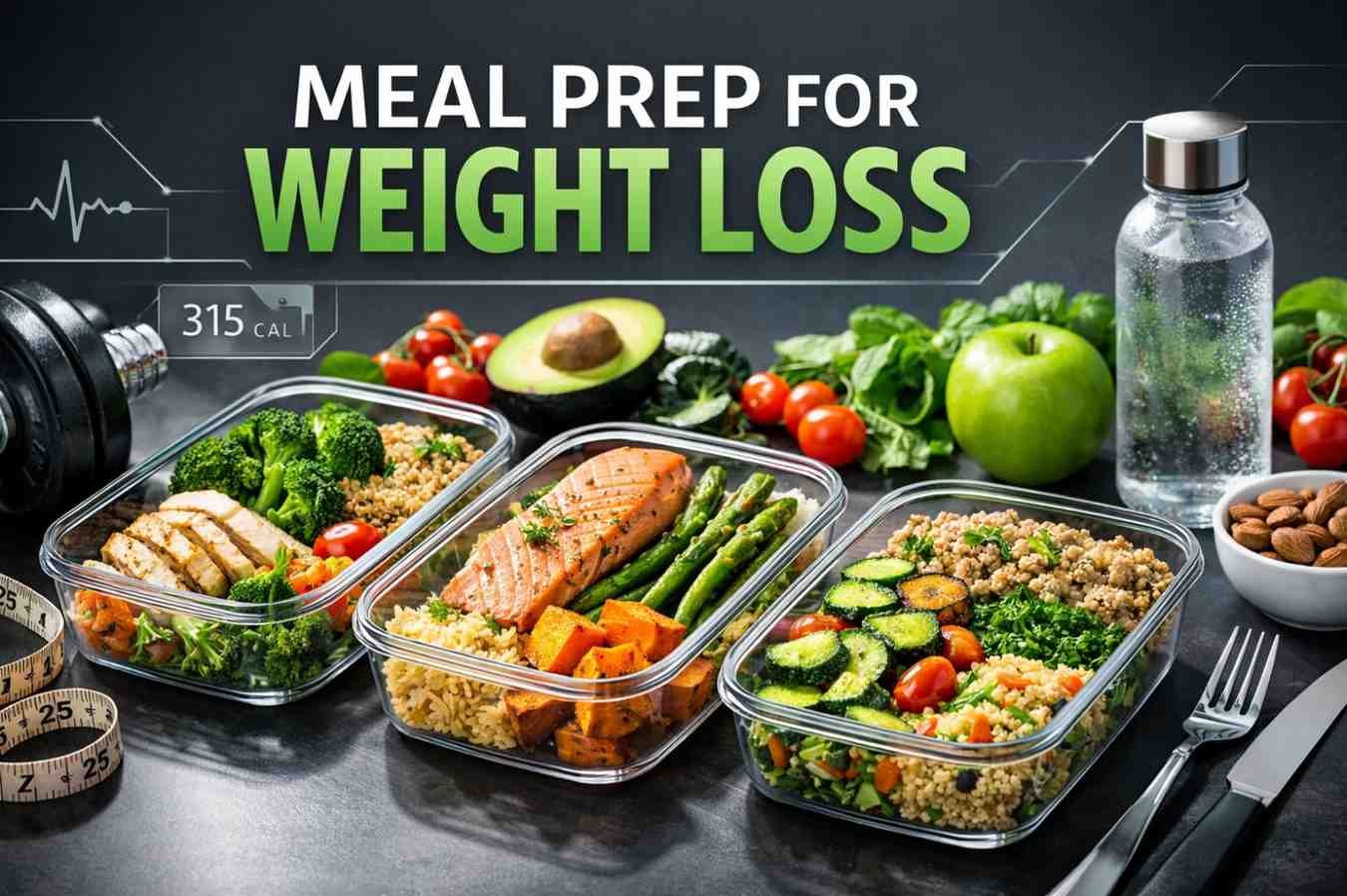
Meal Prep for Weight Loss: Want to lose weight without starving yourself every night? This guide breaks down how to meal prep for real weight loss — practical, no-nonsense, and built for how Americans actually eat.
Meal Prep for Weight Loss: What Actually Works
You’ve probably told yourself you’d start meal prepping “next Sunday.” Then next Sunday came, went, and you ordered DoorDash again.
That’s not a motivation problem. It’s a system problem. Most meal prep advice online is written for people with perfect schedules, enormous kitchens, and a weird love for plain steamed broccoli. That’s not real life.
This guide is different. It’s going to show you how to build a meal prep habit that actually supports fat loss — without cooking every meal from scratch or eating the same sad bowl of quinoa five days in a row.
Why Meal Prep and Weight Loss Go Together
Weight loss comes down to one core mechanic: eating fewer calories than your body uses. Simple in theory. Annoyingly hard in practice.
The problem isn’t knowledge. Most people know that fast food is calorie-dense and that vegetables are good. The problem is friction — those small moments of inconvenience that make the worst option feel easier.
You get home at 7 PM. You’re hungry. There’s nothing ready. You grab chips, order pizza, or eat a handful of random things that somehow add up to 900 calories.
Meal prep removes that friction. When food is already made, portioned, and waiting in your fridge, you make better choices almost automatically. It’s not willpower. It’s just logistics.
A 2020 study published in the International Journal of Behavioral Nutrition and Physical Activity found that people who cooked at home more frequently consumed fewer calories overall and had better diet quality. Meal prep is basically a system for cooking at home more often — without spending every single evening in the kitchen.
What Most Americans Get Wrong About Meal Prep
Here’s the honest version. Most people fail at meal prep not because they lack discipline, but because they try to do too much too fast.
They watch a YouTube video where someone preps 25 containers of perfectly portioned meals over two hours. They try to replicate it. It takes four hours. Half the food goes bad by Thursday. They quit.
The second mistake? Focusing on “diet food” instead of food they actually like.
If you hate meal-prepped salmon with asparagus, you’re not going to eat it when you’re hungry and tired. You’ll eat around it. Then you’ll feel guilty. Then you’ll quit entirely.
Sustainable meal prep should feel like a convenience, not a punishment.
The Foundation: Calories, Protein, and Volume
Before you open a container or buy a meal prep container set from TikTok, understand three things:
1. Calories are the ceiling. You don’t need to obsessively count every macro, but you do need a rough idea of your calorie target. Most adults trying to lose weight do well on a diet of somewhere between 1,500 and 2,000 calories per day, depending on height, weight, activity level, and metabolism. Use a free calculator (TDEE Calculator, MyFitnessPal, Cronometer) to get your number.
2. Protein is your best friend. Protein keeps you full longer. It preserves muscle while you lose fat. And your body actually burns a small number of extra calories just digesting it (called the thermic effect of food). For weight loss, aim for roughly 0.7 to 1 gram of protein per pound of your target body weight. So if you’re aiming to weigh 160 lbs, shoot for 112–160g of protein per day.
3. Volume matters more than most people realize. You want to feel full. High-volume foods (think leafy greens, cucumbers, broth-based soups, berries) let you eat large portions without blowing your calorie budget. Building meals around volume eating is one of the most underrated strategies for weight loss.
The Simple Meal Prep Framework (The “3+2+1” Method)
Instead of trying to prep every meal perfectly, use this simplified structure:
- 3 proteins (batch cooked)
- 2 carb/grain bases
- 1 big batch of vegetables
From those six components, you can mix and match into dozens of different meals throughout the week. This prevents food boredom and makes prep much more manageable.
| Component | Example Options |
|---|---|
| Proteins | Grilled chicken thighs, hard-boiled eggs, canned tuna, ground turkey, tofu |
| Carb bases | Brown rice, quinoa, roasted sweet potato, whole wheat pasta |
| Vegetables | Roasted broccoli, raw spinach, sautéed zucchini, frozen stir-fry blend |
Mix and match however you want. Chicken over rice with broccoli on Monday. Chicken in a wrap with spinach on Tuesday. Ground turkey taco bowl on Wednesday.
Same prep. Different meals. Less boredom.
What to Actually Buy: A Grocery List Built for Fat Loss
Here’s a simplified grocery list that won’t empty your wallet:
Proteins:
- Boneless, skinless chicken thighs or breast (cheaper in bulk at Costco or Sam’s Club)
- Ground turkey (93% lean)
- Eggs (a dozen or two)
- Canned or pouched tuna or salmon
- Cottage cheese (high protein, underrated)
- Greek yogurt (plain, full-fat is fine in moderation)
Carbs and grains:
- Brown rice or jasmine rice
- Sweet potatoes
- Rolled oats (breakfast sorted)
- Whole wheat bread or tortillas
- Beans and lentils (cheap, filling, underrated)
Vegetables:
- Baby spinach (pre-washed = convenience)
- Broccoli (fresh or frozen — frozen is nutritionally similar)
- Bell peppers
- Cherry tomatoes
- Zucchini
- Frozen stir-fry veggie blend
Fats and flavor:
- Olive oil
- Avocados (or guacamole if you’re not cutting calories aggressively)
- Nuts and nut butter (portion-controlled)
- Hot sauce, salsa, mustard (flavor without calories)
- Low-sodium soy sauce or coconut aminos
The goal here isn’t perfection. It’s having enough variety to avoid boredom and enough staples to build a balanced meal quickly.
How to Actually Meal Prep (Step by Step)
Pick one day. Most people choose Sunday, but if Saturday works better, do Saturday. Consistency matters more than the day.
Step 1: Plan your meals for the week. You don’t need a rigid schedule. Just decide, roughly, what you’ll eat for lunch and dinner over five days. Write it down or use an app. This prevents the “I don’t know what to cook” spiral.
Step 2: Cook your proteins. Season your chicken, turkey, or tofu, and cook it all at once. Oven-baked chicken thighs at 400°F for 25–30 minutes = dead simple. Or use an air fryer. Cook ground turkey in a big skillet with onions, garlic, and whatever seasoning you’re feeling.
Step 3: Cook your grains. Rice cooker, if you have one. Instant Pot if you’re fancy. Stovetop if you’re old school. Make a big batch. It keeps well in the fridge for 4–5 days.
Step 4: Roast your vegetables. Toss broccoli, zucchini, bell peppers, or sweet potatoes in olive oil and salt. Spread on a sheet pan. 400°F for 20–25 minutes. Done. These reheat well and hold their texture better than most people expect.
Step 5: Portion and store. Use glass or BPA-free plastic containers. Portion your meals into individual containers if that helps, or store components separately and assemble meals throughout the week. Separate storage is actually more flexible — you can change up combinations without getting locked into the same exact meal.
Step 6: Prep your breakfast separately. Make overnight oats the night before. Batch-cook hard-boiled eggs for the week. Prep a big container of Greek yogurt with berries. Breakfast is the easiest meal to streamline.
Realistic Calorie Breakdowns for Prepped Meals
Here’s a rough idea of what a day of meal-prepped eating might look like, calorically:
| Meal | Food | Approx. Calories | Protein |
|---|---|---|---|
| Breakfast | Overnight oats + 1 tbsp almond butter + ½ cup blueberries | 380 | 12g |
| Lunch | 5oz chicken thigh + 1 cup brown rice + 1 cup roasted broccoli | 480 | 40g |
| Snack | Greek yogurt (plain, 1 cup) + ½ cup strawberries | 175 | 17g |
| Dinner | Ground turkey taco bowl (rice, salsa, lettuce, ½ avocado) | 520 | 38g |
| Total | ~1,555 | ~107g |
That’s a reasonable, filling day. You’re not starving. You’re getting solid protein. And most of it was prepped on Sunday.
Meal Prep for Specific Weight Loss Scenarios
Weight loss isn’t one-size-fits-all. Here’s how to adjust based on your situation:
If you’re trying to lose weight without counting calories: Focus on food quality instead of numbers. Fill half your plate with vegetables, a quarter with lean protein, and a quarter with a whole grain. Limit liquid calories (soda, juice, fancy coffee drinks). Eat slowly. This approach works well for people who find calorie tracking stressful or obsessive.
If you’re on a budget: Beans, lentils, eggs, canned tuna, frozen vegetables, and rice are your best friends. A week’s worth of high-protein, calorie-conscious meals can easily come in under $50 with smart shopping. Aldi and Walmart’s Great Value line are legitimately solid options.
If you’re short on time: Forget elaborate recipes. Rotisserie chicken from the grocery store counts as meal prep. Pre-washed salad bags count. Canned salmon counts. There’s no rule that says meal prep has to be elaborate to be effective.
If you’re vegetarian or plant-based: Tofu, tempeh, edamame, beans, lentils, cottage cheese, and Greek yogurt (if you eat dairy) are your protein anchors. A big batch of lentil soup or black bean chili is genuinely one of the most cost-effective, high-satiety meal prep options out there.
Common Meal Prep Mistakes That Stall Weight Loss
Let’s be honest about what goes wrong:
- Prepping meals that are too low-calorie. Eating 1,000 calories a day might seem like a faster way to lose weight, but it typically backfires — muscle loss, metabolic adaptation, intense hunger, and eventual bingeing. Aim for a moderate deficit, not starvation.
- Too much variety too soon. Trying to make five completely different meals in one session is a recipe for a three-hour disaster. Start simple. Two or three different meals per week are plenty.
- Forgetting sauces and seasoning. Plain chicken and plain rice are technically food. It’s also miserable. Stock your pantry with sauces and condiments (hot sauce, sriracha, teriyaki, pesto, hummus) that can transform a basic meal without adding excessive calories.
- Not prepping snacks. If your meals are planned but you get hungry mid-afternoon, and there’s nothing ready, you’ll grab whatever’s nearby. Prep a few snack options, too. Cut vegetables, portioned nuts, and hard-boiled eggs.
- Using meal prep as the only strategy. Meal prep supports weight loss — it doesn’t guarantee it. Sleep, stress, alcohol intake, and movement all still matter.
How to Keep Meal-Prepped Food Fresh All Week
Food safety and texture are real concerns. Here’s what actually matters:
- Cooked chicken and ground turkey: Fridge safe for 3–4 days. Freeze anything you won’t eat within that window.
- Cooked rice and grains: 4–5 days in the fridge. Make sure it cools fully before storing (prevents moisture buildup and sogginess).
- Roasted vegetables: 3–5 days. Reheat in an oven or air fryer to restore some crispness rather than microwaving to mush.
- Leafy greens: Keep them dry and separate from dressing or other moist ingredients. They’ll last the week if stored properly.
- Overnight oats: 4–5 days easily. Make a few jars on Sunday.
A good general rule: if something doesn’t smell or look right, throw it out. Don’t push it.
Meal Prep Doesn’t Have to Be Sunday
The “meal prep Sunday” concept is everywhere, but it’s not mandatory. Some people do better with two smaller prep sessions — say, Sunday and Wednesday. That way, nothing sits in the fridge too long, and you’re not committing to four hours on your only day off.
Others do “daily micro-prep” — spending 15 minutes each evening getting the next day’s food ready. That works too. The method matters less than the consistency.
Find what fits your actual life. Not someone else’s.
FAQs: Meal Prep for Weight Loss
Q: How much weight can I realistically lose with meal prepping? A: Meal prep is a tool, not a magic solution. Combined with a moderate calorie deficit, most people can lose 0.5 to 2 pounds per week. Results vary based on starting weight, consistency, overall lifestyle, and individual metabolism.
Q: Do I have to weigh my food? A: Not necessarily. Weighing food is the most accurate way to track intake, but it’s not required. Using measuring cups, portion guidelines, or the “hand portion” method (palm = protein, fist = carbs, thumb = fats) works reasonably well for most people.
Q: Can I meal prep for weight loss if I have a small kitchen? A: Absolutely. A sheet pan, one large pot, and a skillet are all you really need. Small kitchens require better organization, not better equipment.
Q: Is it okay to eat the same meals every day? A: Nutritionally, yes — as long as you’re getting a variety of food groups. Mentally, it depends on the person. Some people find repetition comforting and easy. Others get bored fast and fall off the wagon. Know yourself.
Q: What containers are best for meal prepping? A: Glass containers (like Pyrex or OXO) are durable, microwave-safe, and don’t absorb odors. BPA-free plastic is lighter and cheaper. For bulk meal prep, 2-cup and 4-cup containers cover most situations.
Q: What if I don’t like leftovers? A: Focus on components rather than full meals. Instead of prepping a complete dish that you’ll eat reheated four times, prep raw ingredients (cooked grains, proteins, cut veggies) that you can quickly assemble into fresh-feeling meals each day.
Q: Is meal prep expensive? A: It can be cheaper than eating out, significantly so. A week of meal-prepped lunches might cost $25–40 total. That same number of lunches from fast-casual restaurants might run $60–80 or more.
The bottom line is this: meal prep works because it removes the decision fatigue that leads to bad choices. You don’t have to be perfect. You don’t need matching containers or an aesthetic fridge. You just need food that’s ready when hunger hits — and a strategy simple enough to actually repeat next Sunday.
Start small. Adjust. Keep going.
SUGGESTED POST >> Easy Vegan Meal Prep Ideas That Deliver: No More 6 PM Panic